


Description
Digital downloads for the Wera metric hex L key holders so you can print locally and avoid shipping costs.
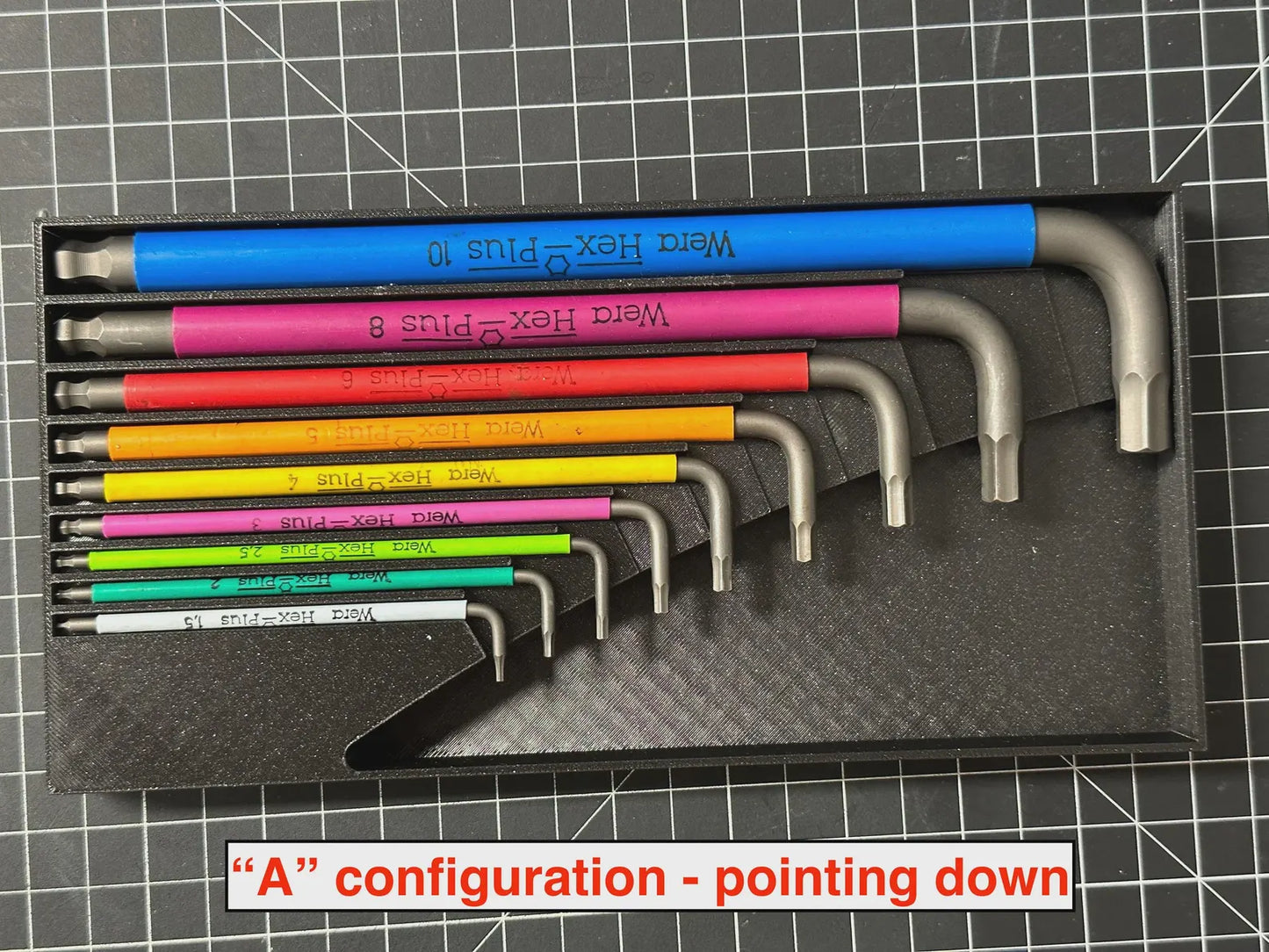
The Wera 73593 hex key set is a popular one among bike mechanics, offering a ball end on the long leg and their "Hex-Plus" end on the short leg. The holder that comes with it isn't great, though, requiring you to pull a key out of the holder each time you need it. Not too bad if they're infrequently used, but when you're constantly grabbing another, this can be a waste of time.
This is a holder for that set, covering the entire 1.5-10mm range. It was originally designed to work with Kaizen foam which is often used in travel toolboxes, so is 20mm deep and the tools are held flush with the top surface which would help keep them in place in a travel toolbox, but it also keeps them easy to grab quickly.
Overall dimensions: 240x120x20mm (9.5x4.7x0.8in) - appx 140g (5oz)
Will this work with other L wrench sets? All I can say is a definitive "maybe".
There are two configurations based on how you want to use them, and they can be turned around for a total of four configurations, which are detailed in the photos. Note that "B" is just a mirror of "A".
Configuration "A" - with the short legs pointing towards you, the cutout is on the right and the Wera text on the handles is upside down. Rotated, the cutout is on the left and the text is right side up.
Configuration "B" - with the short handles pointing towards you, the cutout is on the left and the Wera text on the handles is right side up. Rotated, the cutout is on the right and the text is upside down.
Both files are included. Couldn't you just mirror configuration A to get B? Sure, (that's how I generated it anyway) but then the text on the bottom would come out backwards.
Print instructions - pretty much up to you. I usually print at a coarse layer height, 0.28mm with a 0.4mm nozzle on my Bambu printers. You can print finer, it doesn't buy you much and takes more time. Nothing special in terms of shells or infill, no support needed. I always print in PETG for the heat resistance but most of the time these are living in a toolbox and thus won't see the type of temperatures you'd find in a car on a sunny day, so PLA would be just fine.